By Georgina Reid. 1 December 2025. Download PDF.
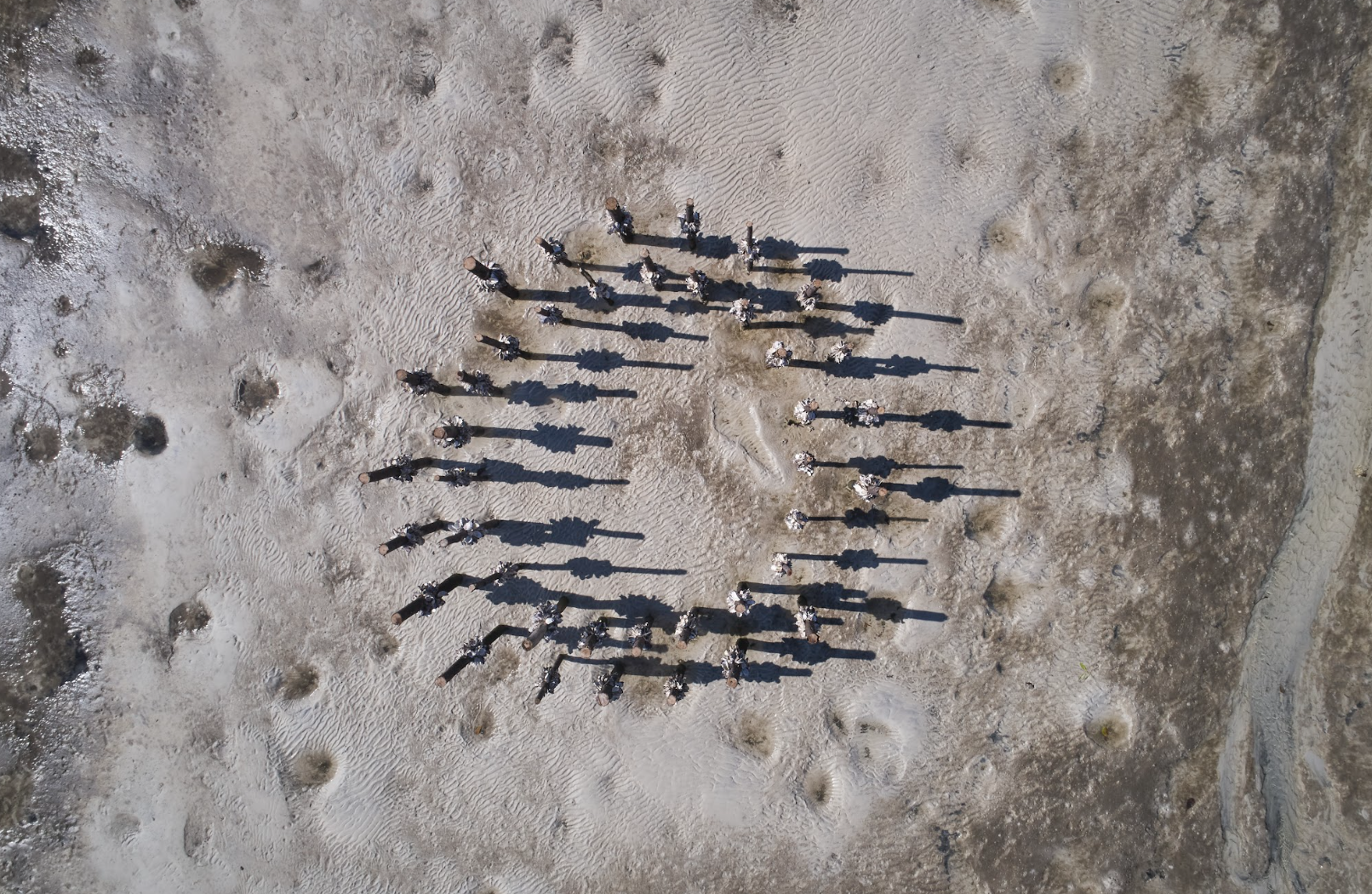
Image: Megan Cope, Kinyingarra Guwinyanba, 2022–ongoing. Installation view, intertidal zone off the coast of Minjerribah/North Stradbroke Island, Queensland. Courtesy the artist and Milani Gallery, Meanjin/Brisbane. Photo: Cian Sanders.
Quandamooka artist Megan Cope’s Kinyingarra Guwinyanba (2022) is a striking example of art as a relational and generative practice; art for, and with, Country. It’s a living artwork planted in the waters of Minjerribah/North Stradbroke Island in South East Queensland. On 26 January 2022, Cope and helpers began planting around 100 timber posts wrapped in bands of oysters in the island’s intertidal waters. Mudflats like this, according to marine biologist Dr Nigel Preston, would have been carpeted in oysters prior to European invasion, but colonists saw the reefs and associated middens as easy sources of lime for construction, and they were soon decimated.
The cleaned oyster shells — waste products from local restaurants — provide a substrate for wild oysters to attach to and grow. Cope tells me over the phone that since 2022, the oyster growth on the poles has tripled. She’s about to head back for another workshop with community, making and planting another 100 poles. ‘It is a real collaboration with Country’, she says. ‘Aboriginal people have become the oldest living continuous culture on earth not through subjugating [and] controlling nature, but through observation and collaboration.’ The project is about returning to this cycle, ‘allowing nature that sentience and power’.
Moving beyond the confines of gallery walls and institutions, Cope’s work illustrates the capacity of art to not only critically, but physically, engage with the more-than-human world at a time of climate crisis. ‘When we’re on the edge of catastrophe, representation falls short of what needs to happen’, she says. The role of artists in these times, Cope suggests, might be embedded in active, radical care: creating ‘language, strategies and tools’ to help communities and individuals take on the responsibility of caring for Country.
“It is so urgent, it is so critical. If we’re not listening to what nature is telling us, we’ll pay the price. It’s in our own interest. In the end, that’s what this project is about. It’s about understanding that sentience.”
The work emerged from time Cope spent with her uncle on Minjerribah, often getting up at 4am and heading out to his oyster leases with him. Listening, watching, learning. ‘I feel like it’s what the place told me to do’, she says of Kinyingarra Guwinyanba, ‘it’s what it said it needed.’ This is a project not for people but Country. ‘It’s for the oysters and it’s for all of the creatures that rely on the foundations that oyster reefs provide,’ Cope says in an ABC Art Works documentary. ‘How do we as artists empower ourselves to make things that make space for the living?’
Thaiday and Cope’s work, like that of many other First Nations Australian artists, turns towards the ghosts of colonisation, the shadows of industrialisation, the uncanny effects of an increasingly unstable climate. But the work does not turn towards Country. This is not the right language. It might be truer to suggest Country is the work. Or, as the Yarrenyty Arltere artists write in their artist statement for the soft sculpture installation work, Beautiful Ulkumanu (old woman), After the Rain 2025 for the 5th National Indigenous Art Triennial, becoming Country is the work...
Extract from ‘Becoming Country’, published in The Annual 2025.