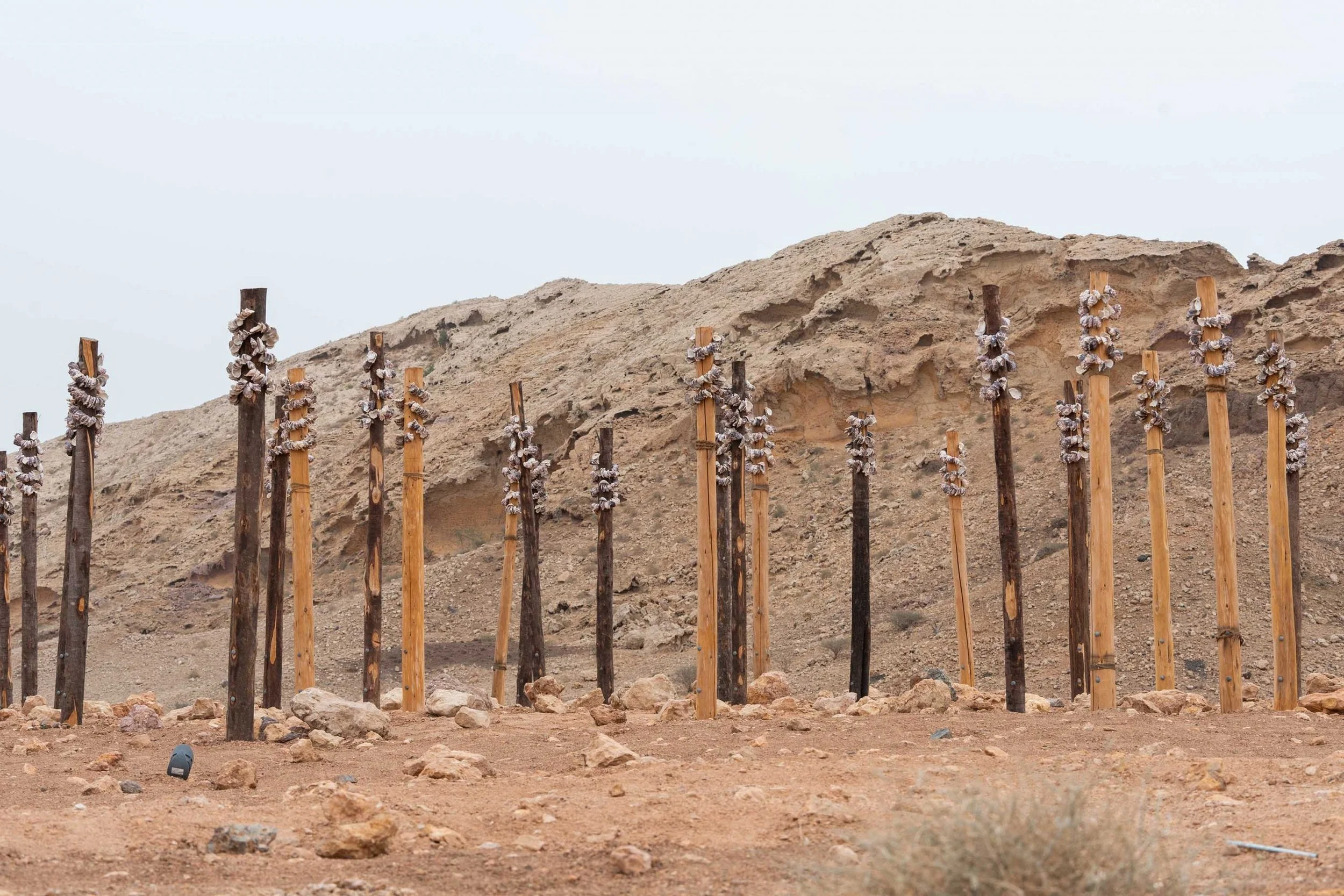
Megan Cope, Kinyingarra Poles, 2023–24. Installation view, Sharjah Biennial 16: to carry, Buhais Geology Park, Sharjah, 2025. Assisted by the Australian Government through Creative Australia. Courtesy of the artist and Milani Gallery, Meanjin/Brisbane. Photo: Ali Alfadly.
Coinciding with the finissage of the Sharjah Biennial 16, this conversation brings in dialogue its five curators, Natasha Ginwala, Amal Khalaf, Zeynep Öz, Alia Swastika, and Megan Tamati-Quennell, who reflect on the collective process of elaboration, creation, and sisterhood they have shared before and during the biennale, carried out in times of rage, and yet, tenderness and imagination.
BARBARA CASAVECCHIA
Thank you for being here, all of you. I would like to start from the title you chose for the biennial, to carry:
to carry a home
to carry a history
to carry a trade
to carry a wound
to carry equatorial heat
to carry resistance
to carry a library of redacted documents
to carry rupture
to carry Te Pō [the beginnings]
to carry change
to carry songs
to carry on
to carry land
to carry the language of the inner soul
to carry new formations
to carry the embrace of a river current
to carry sisterhood and communal connection
to carry the rays of a morning without fear1
It is a verb, and this brings with it an action, a movement. Ursula Le Guin’s “carrier bag theory of fiction” immediately resonates as a reference, to me. Was this idea of being in a process, and especially in a process of bringing forward, part of your reasoning? How did it all start?
NATASHA GINWALA
As you’ve said, that is how the title called out to you. And I think everyone who visits has their own pre-image. It’s great when a biennial seduces you, and builds a relationality. In the early stages of our process, Megan addressed the responsibility of the guest and the host also in terms of the artists we would bring in, who would come to Sharjah—often for the first time—with their own embodied histories and forms of memory keeping. This prompt “to carry” unleashes multiple threads from embodied journeys and experiential territories that are hosted and grow into lively ensembles, through individual artists and several collectives. A framework rather than a theme—we started with this question of what it entails to carry a home, ancestors, and political formations with you. It distilled and cross-fertilized from there, opening up into our more propositional/poetic manifesto.
AMAL KHALAF
That process was one of the many refractions of how we have been communicating with one another. Distilling that verb, as Natasha says, and then building collectively a poetic manifesto, was like an invitation to all of us. And to the artists as well, who were making the works, because it started to add a different color to how they had thought about it. The verb was really important in order to reflect this constant movement and change, which is not just about reactivity to the horrors of the now, the past, and the future, but rather the idea of being in flux.
ZEYNEP ÖZ
Every one of us and our respective projects fit into that question. To answer it, I would say it took a long, long time, but also a very short time. Since we had been revolving around this interrogation forever, when we finally had to come up with a title, it was almost instinctive. Natasha and Amal already talked about why it was important to use a verb. But we also talked about how making lists is a political act, a way of keeping track, saying things over and over again, and highlighting them. We felt that that action of generating different things, actions, and possibilities is something we all share.
MEGAN TAMATI-QUENNELL
I agree with all that has been said. I felt like the question was something I could inhabit, and it resonated strongly with the projects I was developing for ihi, my section: the idea of carrying land, culture, songs, knowledge, history, notions of time, but also rupture, made sense with each one of them. It did take ages to find something under which our individually authored projects could coalesce, but it was also, like Zeynep said, very fast once we settled on the question as an open-ended proposition, because it had a collective resonance.
BARBARA
The carrying of different voices, as in storytelling, poetry, and rhythms dictated by the body, are forms of polyphony. Why did you want to use specifically this language, instead of building a more theoretical curatorial framework?
NATASHA
This biennial process really did commence with thinking from the gut, conveying a lexicon of emotion, lived ideas, and practices that matter to us right now. I think it has a lot to do with being honest with ourselves and with one another in a moment when many of the most vital institutions in our societies are failing us. Rather than entering a specific genealogy of thought or political formation, we instilled different modes of reception and schemes of cohabitation for the creative voices being invited to participate. The concern has been to broadcast resonances from life-making, narrating from plural ontologies, and methods of doing that are situated, and not abstractions.
For some of us, as cultural organizers who maintain interdependent smaller-scale establishments, precarity and daily vulnerability are parts of the creative process. So it’s precious to work on a biennial that you can truly use as a resonance chamber, a testing ground, and a place of gathering with wide-spanning infrastructure. It was crucial for me to wrestle with how South Asian historical experience and social realities play a role in this edition, while at the same time, the ongoing wars point to growing urgencies that traverse beyond aesthetic solidarity. Rather than leaning into a specific line of thought, there were grounded dialogues, learnings through my travels in the Indian Ocean context, and an array of material intelligences that came together to shape the biennial step by step.
MEGAN
I did work primarily with a First Nations positionality in relation to place, and that idea of embodying the meaning of “to carry” became a fundamental element of my project, as Natasha was saying. ihi did ask the question of what it is, or might be, to be a guest in someone else’s land, country, or context. To consider what it means to be a visitor, who does not necessarily have deep connections and history with, or knowledge of, a locale, and what your responsibilities are as a guest. In First Nations cultures, there is what we would call tikanga, which means protocols or practices for being a guest in someone else’s land/culture/country, so I worked with that, if tangentially.
Within that, I also wanted to ensure that the artists I was working with had the opportunity to bring their uncompromised whole selves, ideas, practices, and histories to Sharjah. I wanted those artists and those works—deeply engaged in their own contexts and occupying a situated position in their respective cultures—to feel supported, and seen, and read, in this part of the world. How, for example, could I bring images speaking of ancestral landscapes in Hawaii, like those photographed by Kapulani Landgraf? I needed to think about what the synergies or cross-cultural connections were between Hawaii and his experience and here. That’s the position I came from. My offering was poetic, and not everything was decoded. I did try to keep the integrity of each work intact.
AMAL
I like the idea of the choir. Language and knowledge, and I would say women’s knowledge, are often the result of an embodied transmission. Whether we are talking about technological change, politics, or sacred practices with earth and water, I feel like there is a type of language that we wanted to privilege, and we believe that artists have the best technologies to transmit it to audiences. It was really important to bring into our process the wider umbrella of language, and there have been so many processes in the making of the works on view, so many gatherings, and collective moments, and mini-choirs—literally and otherwise. Alia has lots of amazing stories to share.
ALIA SWASTIKA
I really agree with Amal’s reflections on how we tried to use a different vocabulary. I’m rethinking also how language represents a community, and how we can carry its many voices. My process in preparing the biennial tried to combine the working together of contemporary artists and different Indigenous communities. So, for example, I went to some islands and villages in remote areas of Indonesia, and instead of asking the artists to create something from their investigations or their researches there, we wished to give the stage to people who had never previously been acknowledged as artists or activists. For me, that notion of representation and the transformations of language from one context to another, the very diverse ways of speaking, were also an occasion for reflecting on my own curatorial practice. There have been very rich conversations between the communities themselves, the artists working with them, the activists, myself as curator and all the guest curators I have invited to work with me, and writers, and filmmakers. I’ve really enjoyed orchestrating all these different languages.
Amal emphasized also how we tried to give more space to women’s knowledges. In the case of Southeast Asia, for instance, many of these practices are still part of everyday life. People are making things that have always been seen as craft, and never really as sources of knowledge, but now there is a movement in the creative industry toward that type of work. I think the pandemic deeply changed the ways people look at the villagers and the Indigenous communities, trying to learn from their resilience, and why their connections between humans and the cosmological order could help us better understand the world.
BARBARA
Biennials have their own histories, genealogies, and chronologies as places for experimenting and rethinking institutions. Was there any example that was specifically inspiring to you, or something you really didn’t want to reproduce? It’s always interesting how knowledge is carried from one place to another. And what is to be learned and gathered from various times and generations.
NATASHA
I believe we did not want to reproduce an arc of institutional critique, but there were things that came from the directions we’ve taken—like residencies, different forms of gathering in order to facilitate the creation of works, hybrid publishing formats, producing vinyl records, turning the venues into environments for performance and recitals, and ways of stitching together these dynamic tangents of making. Rather than succumbing to the logic of white cube configurations, I was guided by the openness of courtyards, the inherent porosity in the heritage sites, and spaces of listening, resting, and sounding within the biennial—resisting the museological to render forms of display that welcome the body seeking joy and inquiry.
ZEYNEP
None of us had worked together before, and we all come from different curatorial backgrounds. I think our relationships to Sharjah are various, and our relationships to different institutional models are likewise various. I’ve learned a lot from the ways in which everyone has operated, and vice versa. I feel that the reason it worked is because we had individual projects to follow, but we also had front-row seats to one another’s processes, as well as an amazing resource “library” in the other four. Sharjah is very special in allowing for various formats to take place at the same time. Not a lot of biennials do that. Some of us had longer commissioning processes, some of us worked site-responsively, and so on, and we each experimented in our own ways.
If there’s one thing I might mention as a precedent to this biennial, it’s that, for me, Sharjah has been an important place for experimentation and for growing communities. In practical terms, for me it was amazing to be able to tinker with the format of both the thirteen YAZ Publications and the spatial exhibitions, and to try to oscillate between those two formats, during both research and production. Akira Ikezoe talks about nuclear energy in the animation and the paintings we commissioned from him, but then there is also the biologist Sophia Tintori, at work on tracking down worms in Chernobyl, discussing her experience while driving around for her lab research. Likewise, there were works from Luana Vitra and Ayman Zedani about mining and energy resources in their respective geographies of Brazil and Saudi Arabia. There was Off the Grid, a publication dedicated to Onur Ceritoğlu, whose work investigates energy conversion in an off-grid community seeking sustainability.
AMAL
Has anybody yet mentioned the word “trust”? Because I think that’s a given in any collective process. We deeply felt that trust, both mutually and from the Sharjah Art Foundation, with a constant feeling of possibility that, for me, kept this entire exercise exciting. I had not worked on a biennial before. I usually work with artists on projects that are, let’s say, three to eight years long. My timescales are so extended, and a biennial feels so short, but I still wanted to activate and stretch the possibility of trust. If there was anything I wanted to test, it was how much we could bring that intimacy—that’s the right word, to me—in the relation with the artists, with one another, with an institution.
MEGAN
Like Amal, this was my first biennial. It has been a great opportunity that I am extremely grateful for—an opportunity to extend myself curatorially and to work globally, which I loved. And it was significant to do so alongside these women, my global contemporaries, each renowned for their work and curatorial practice and ready to bring to the table their intellect, positioning, and sensibilities, as well as the networks of artists and communities they represent and work within. It was an unequaled opportunity to platform artists from my part of the world. There was a tremendous amount of trust from the foundation and its president and director, Hoor Al-Qasimi, that enabled us to curate the shows.
For instance, I invited the extraordinary artist Saffronn Te Ratana, who does not usually participate in the art world, because it leaves her cold. She helped build Te Rau Karamu, a marae (meeting house), which was a communal project in Wellington that has won countless awards for its design, art, and architecture. For her, that was the pinnacle, and she thought that everything else would be vanity. But she agreed to participate in this biennial because of our mutual connection and trust relationship, and also because being able to present her work in a largely non-Western context and engage with the people and cultures here was truly important to her. I am so privileged to have her in the show. Her work carries Māori knowledge to the Gulf. Also Raven Chacon’s sound work at Al Madam, related to his own history as well as the history of the UAE and what he called “forced placement,” again carried knowledge and understanding of a situation that occurred both here and in his own country, cultural context, and environment.
ALIA
I’d like to connect with my experience of being, together with Hoor, part of the International Biennial Association. This means I’m quite engaged with the biennial world, especially other biennials in Asia. Twenty or maybe thirty years ago, the basic idea of an international biennial was to bring in international artists and ask them to make big projects without really thinking about how to build sustainable relationships or conversations with the local community. Over the last ten years, things have been changing a lot, together with the idea of decolonizing biennials as a new way of practicing internationalism. I don’t want to call it a trend, but let’s say it’s a new direction. Now, a good call for a biennial is how you interpret and dig into the narratives and the history of one specific locality, while at the same time opening it to wider conversations with international artists and audiences.
NATASHA
Before this, I had never seen so many different modes of exhibition making being tested out in such variety within one biennial. The multiplicity of venues helps, of course, and I’d like to extend respect to Hoor and the whole foundation team for the ways in which they have created architectures for staging a major exhibition, which have a lot to do with conservation and restoration as durational institution building, as well as prioritizing circulation to the broader cultural heritage and resources in Sharjah for its working communities.
I was fascinated by the heritage houses, especially Bait Al Serkal, which is a former hospital where artists Rajni Perera, Naeem Mohaiemen, Sky Hopinka, Pallavi Paul, and Fazal Rizvi responded to built features, such as indoor water wells, while addressing themes such as care work, death, grief, loss, or the transmission of ancestral knowledge from one life state to another. At the same time, the white-cube spaces around Al Mureijah permitted me to introduce pioneering yet overlooked artistic figures such as Bangladeshi modernist SM Sultan and VISWANADHAN, a painter and experimental filmmaker in his eighties who left Kerala in 1968 and has been living in Paris since. There is a huge demographic of Kerala residents employed in the UAE, and even as part of the Sharjah Art Foundation team. Yet it isn’t often that cult artists from Kerala get celebrated in exhibitions and biennials. Adding a significant chapter of VISWANADHAN’s oeuvre to this edition was a step in this direction.
BARBARA
One of the many lines of your manifesto reads: “to carry room for tenderness and rage.” We are inhabiting a moment of incredible rage, tenderness, and grief, which we’re experiencing in endlessly different ways. Why did you highlight this combination as especially meaningful.?
ALIA
I was the one who proposed to use the term “tender.” I felt it was important, while working together with my wonderful colleagues here, and the people in the foundation, and all these artists, to generate a good energy for people to carry each other. In a way, we were also thinking of our relationship with wider contexts, like ecological and environmental knowledges. I was reflecting on how we could create tender conversations, pay attention, and just be there for one another. We have to listen, too, and that’s why we introduced lots of poetry and songs, because the practice of listening, radical listening, can form solidarity and togetherness. A word like “tender” can help us question our ways of living, or connecting to each other. It’s all about how we want to look and build the world together again.
AMAL
Speaking of rage, I think it lives in the concepts of grief and lament, which have been very present in so many conversations. Rage comes also from some questions each of us have, as art workers, as cultural workers, as people. I’ve been thinking a lot about where these emotions are expressed in exhibition spaces. Are they really allowed to be held, and to be felt? In every biennial and museum, there are works embodying and communicating such emotions, but in what way are we able to receive them? It’s something we’ve been attempting to hold, and carry: to be tender, to be enraged, and to be grieving. It’s been interesting, in the editorial process, how to not water down those emotions. How artists may take part in this composting process, to take this violence and think about how it is scarring us on a daily basis, but also how to imagine a more life-affirming world in the midst of this necropolis that seems to get bigger every day. Hopefully, in this biennial, there’s space for those emotions to be present and for audiences to share them.
ZEYNEP
Personally, I don’t want to ignore grief, but I also want to be hopeful. I thought of fiction and science fiction, specifically, as generative vehicles. This idea of creating, imagining, thinking, and being hopeful, to me is always necessary. I wish to see what people are able to generate. There’s a moment for grieving, yes, but there’s also a moment for imagining. And creating a space for doing that is so important.
A lot of the artists and contributors that I worked with were thinking about economic collapse in a time like this, where there are accelerated technological changes, and what that means in terms of mobility, displacement, and dispersing of communities. A lot has to do with what you leave behind, the trash or waste that we are embedded in, the memories that get flooded. Artists like Raafat Majzoub, Fatma Belkıs, or Liu Chuang speak directly to this kind of shifting of communities and materials.
There can also be a certain amount of doomsday-ing in all of this, and I think it’s important to give things a perspective with history. There have been many moments of accelerated change, and somehow, on the other side, there are stories to be cherished, so I wanted to concentrate on that, to think of possible scenarios of relief and construction. And I think there is a lot of historically informed reimagining in these projects.
MEGAN
I suppose I’m close to Zeynep, in a way. A lot of the artists I invited, as First Nations, are dealing with colonization and speak about that in their work, directly or obliquely. There is both deep rage and deep grief at the inequities of situations. There are traumas that have been carried generationally, and conditions that have been forced upon people. They have inherited violence and violent practices designed to extinguish Indigenous people, their cultures and ways of being. So, many respond to the impacts of that, and to the colonial onslaught that is ongoing.
But I didn’t want to be only in grievance mode. I also wanted to show imagination, aspiration, innovation, resilience, resistance, response, and I suppose survival and change. Even the idea of lament, to me, speaks of our ways of navigating grief, but is not just about trauma and loss; it is a human condition that can be expressed in the abstract, poignantly and poetically. ihi is a Māori concept related to a physical rather than a spiritual power. It commands awe and respect, and it is really about a transcendent power—power with or within.
There are works like Luke Willis Thompson’s video Whakamoemoeā (2025), which imagines a constitutional change in Aotearoa. It charts two hundred years of Māori struggle for tino rangatiratanga, or Māori sovereignty—Māori resistance and resilience—but also a way forward. It is based in the year 2040 and presented as an imaginary state broadcast about a recent constitutional change at Matariki, the Māori new year, moving from a colonial Westminster-style governance to an Indigenous plurinational state. What might that bring? What would be the impact of adopting that form of governance? Would it be of benefit to all, or just to First Nations people? What would the impact be internationally? These questions are for all of us.