By Madeleine Swain. 23 March 2026. https://www.artshub.com.au/news/reviews/system-release-review-the-welcome-return-of-the-tarrawarra-international-exhibition-series-2851536/.
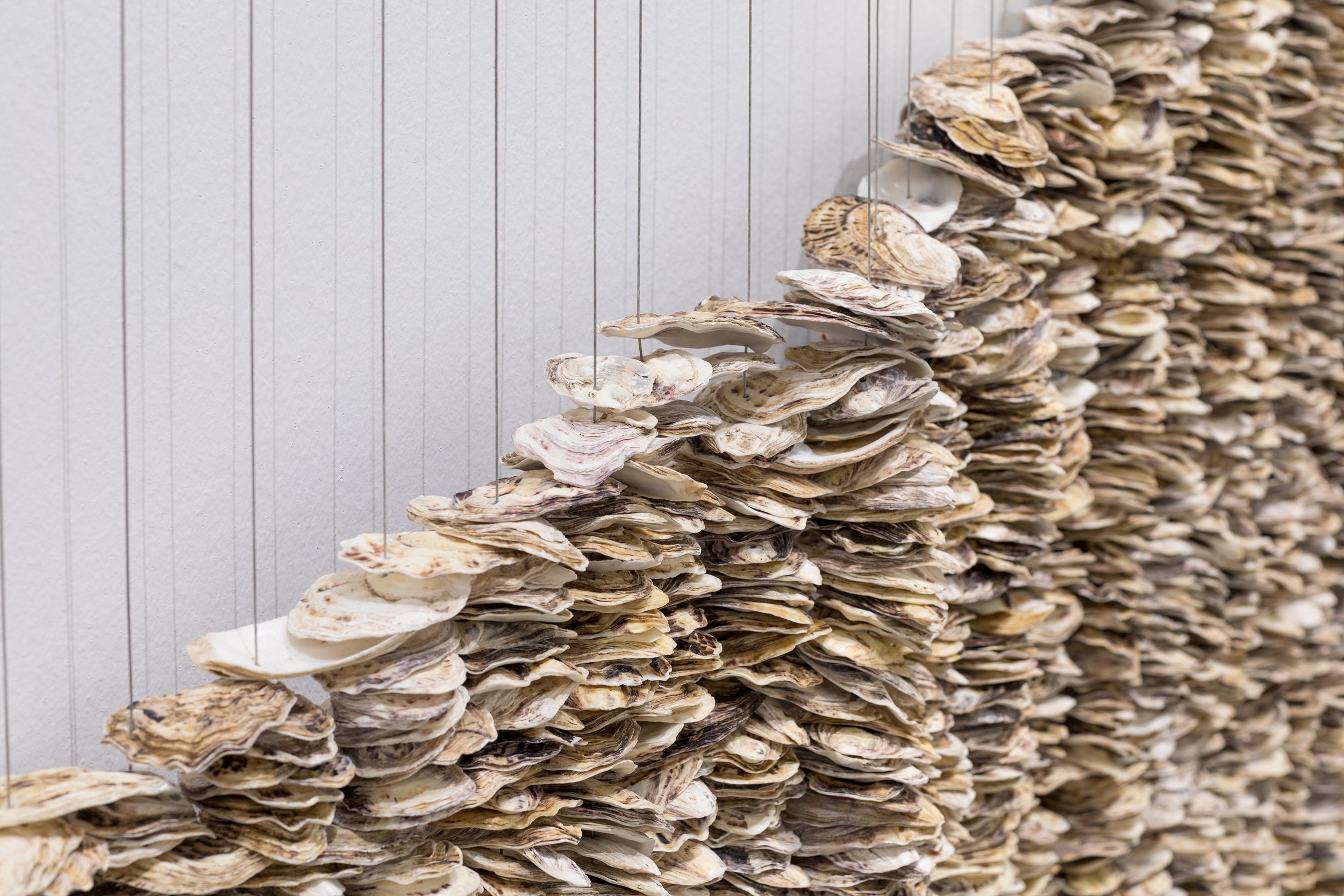
Megan Cope, A Great Depression, 2024, kinyingarra (oyster) shells, stainless steel wire, 310 x 500 cm. Installation view, TarraWarra International 2026: System Release, TarraWarra Museum of Art, Healesville, 21 March – 5 July 2026. Photo: Andrew Curtis.
In times of doom and gloom, can there be a more audacious, if not totally radical, artistic act than flipping the narrative and proposing that perhaps what we are seeing is less a system collapsing, and more one simply being released?
This was the launchpad for Dr Emily Cormack when curating the latest exhibition at Victoria’s TarraWarra Museum of Art – the anticipated return of the TarraWarra International exhibition series. Established in 2013, it has been on pause since the Covid-19 pandemic but now resumes with System Release.
Cormack’s proposition being that instead of looking for artists reacting to world events with despondency and pessimism, she would rather present 10 artists responding to contemporary worldwide precarity with explorations of possible futures and fresh systems of order.
The 10 artists in from Australia, Aotearoa/New Zealand and Mexico are working in a wide range of mediums, but each has something to say about history, permanence and natural evolutions that are outside of the everyday.
Exploring the idea of expansive aeons dwarfing the petty concerns of a species that has only been on the planet for a fraction of the time it has existed, Melbourne artist Nicholas Mangan’s contribution, A World Undone (2012), uses three distinct mediums – photography, film and sculpture – to consider the 4.4-billion-year-old mineral zircon, sourced in Western Australia from some of the earliest sections of the Earth’s crust.
Whether crumbled in a slim vitrine, ant-farm like, exploding in slow motion in a mesmerising film clip (in a very dark room – watch your step) or juxtaposed in photographs with artefacts from Mangan’s grandfather’s mining days, the mineral speaks of ages past and a plausible future.
Quandamooka artist Megan Cope is working in similar territory, building on a practice that has seen her create regenerative artworks on Country with hand-made oyster poles as well as installations comprising mounds of cement oyster shells.
Her sculpture wall work in System Release, A Great Depression (2024), features hundreds (thousands?) of oyster shells threaded into a pattern that references both geological strata and middens that existed for millennia before colonialism destroyed them, repurposing the shells for building materials.
Cope’s practice speaks to Country, to living cultures, to reclamation and simple science – and in A Great Depression she’s also mindful of ‘reduce reuse recycle’ by sourcing oyster shells from restaurants. The work then also comments on the current status of oysters as a food of the wealthy and privileged – a long way from its traditional consumption as an everyday food by First Nations people living near the sea, or the working classes of England. It’s a powerful piece, with layer upon layer of meaning…
—
Extract from System Release review: the welcome return of the TarraWarra International exhibition series, published on ArtsHub.